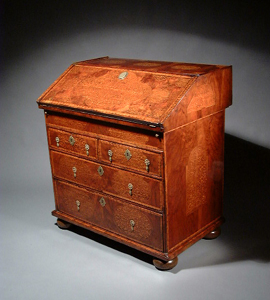
A William and Mary burr walnut and seaweed or arabesque marquetry Bureau, in the manner of Samuel Bennett, the rectangular moulded top above a sloping fall, with an important lock, enclosing a sliding well, four short and one long drawer and four shaped pigeonholes; above two short and two long drawers on later bun feet.
37½” (95cm) wide 25 ” (64cm) deep 40” (102cm) high
£68000
Provenance Illustrated in English
Furniture Charles II to Queen Anne.
Sold by H Chapman & Son Scarborough on 15 September 1955.
Seaweed or Arabesque Marquetry was made fashionable by the court of William and Mary and marks the culmination of the marquetry cutter’s skill. The method was more straight forward , inasmuch as only two woods were used; box or holly for the pattern, and walnut for the ground. However the fineness of the scrolling patterns demanded extreme care and very fine saw, kept exactly on the lines of the pattern, and held at a slight angle, which overcame the trouble of a wide joint caused by the saw gate.
English walnut carcass furniture of the late 17th Century, finished with elaborate veneers and marquetry, is synonymous with the Gerrit Jensen (1680-1715). Jensen was the first cabinet maker to achieve individual distinction for his work as ‘Cabinet maker in ordinary’ to William and Mary. Like Chippendale in the mid 18th Century hids name is often wrongly associated with any fine English cabinet work of the baroque period, especially examples incorporating seaweed marquetry. Veneer and marquetry skills were brought to England with the return of Charles II in 1660. The subsequent arrival of Dutch craftsmen, from whom Jensen is thought to have descended, and the later brass and tortoiseshell marquetry designs of Boulle and Piere Gole introduced by exiled Huguenot artisans, revolutionised English cabinet making. By the late 1680’s marquetry patterns had evolved into their own distinctively English style. Animal and floral motifs were rejected in favour of the intricate symmetrical patterns of seaweed marquetry, enclosed within panels upon a plain walnut veneer field. Seaweed marquetry panels arranged in circles and spandrels around a central medallion were employed as decoration upon the tops of the tables and the main facades of cabinets and bureaux with regular lozenges decorating drawer fronts in what can be called the Jensen style.
The Jensen style describes the marquetry work of a number of cabinet makers, known and unknown, working mostly in London during the reign of William and Mary between 1688 and 1702. Whilst this formal arrangement of the overall design in such pieces is largely constant there are considerable differences to be found in the quality of the Seaweed marquetry itself. The work of Jensen, when seen in pieces such as the cabinet commissioned by the 6th Duke of Somerset (now at Syon House) or a table at Petworth, shows a quality of craftsmanship and fluidity of style rarely paralleled by his contemporaries.
This bureau, dateable from the seaweed marquetry and bun feet to around
1700, is an excellent example of this group of craftsmen and is more typical
of a London master craftsman such as Samuel Bennett than Jensen. Bennett
of Monmouth Square London was active from 1695 to 1741 and was one of
the first London Cabinet makers to label his more ambitious pieces. (
Three seaweed marquetry pieces are known; a cabinet labelled Samuel Bennett,
Monmouth Square and two bureaux labelled Samuel Bennett Fecit.)Of the
documented London makers of this time working with veneer Bennett is one
of the few known to have employed seaweed marquetry decoration. The quality
of the bureau’s marquetry is of a similar standard and style to
known work by Bennett, the seaweed inlay being cut in a consistent thickness
to a strict formal arrangement within each inlaid frame.