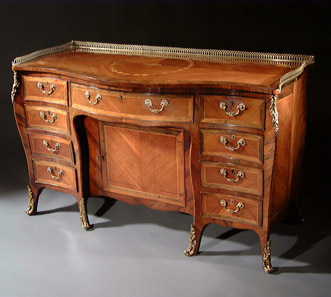
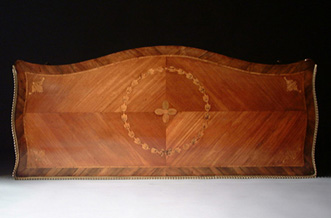
A fine amaranth, and tulipwood and marquetry serpentine kneehole commode, in the manner of Pierre Langlois, the quarter veneered top centred with a florette and surrounding ribbon tied wreath of husks, the crossbanded border with engraved foliate spandrels and three quarter pierced brass gallery, the front with a central frieze drawer above a cupboard flanked by eight drawers, the projecting angles with gilt bronze mounts, the feet with pierced sabots.
48” (122cm) wide 21” (53cm) deep 29½” (75cm) high
£38000
Provenance: Maple and Co. International 141/150 Tottenham Court Road London. Shown at Grosvenor House Antique Fair 1972.
The curved bombé and serpentine top of this piece shows the influence of the émigré French ébéniste Pierre Langlois. Langlois trained under the great Parisian ébéniste Jean-Francois Oeben before moving to London. By 1759, he was well established, specialising in cabinets, commodes and secretaires. The use of brass or ormolu, such as the pierced, waved gallery of interlaced arcading and the ormolu feet mounts cast in acanthus, c-scrolls and terminating in “tightly scrolled French feet” is typical of the French style introduced by Langlois. The floral marquetry to the top, reflected in the design of the handles, and the extensive use of veneers to create decorative geometric patterns from the grain of the wood were further innovations.
In his lifetime Langlois developed a fashionable clientele, including
the Duke of Bedford at Woburn Abbey, the Duchess of Northumberland at
Alnwick and Horace Walpole at Strawberry Hill. It was their patronage
that helped to establish the popularity of the style. Consequently, his
work inspired similar designed pieces by most of the top London cabinet
makers and designers of the period, such as John linnell, John Cobb and
of course Thomas Chippendale. Chippendale published designs for dressing
tables and commodes derived from Langlois in the third edition of the
Director published in 1763 (plate CXVIII). However this piece appears
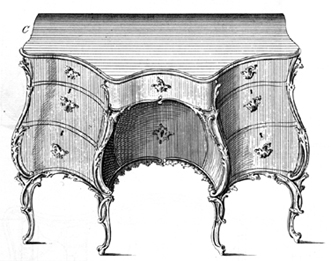
to be derived from a design for a ‘Dressing Table Commode’
taken from Ince and Mayhew’s pattern book, The Universal System
of Household Furniture, published in 1762 (plate XLI illustrated) notably
the arrangement of the drawer around the serpentine frame and shallow
kneehole. Like Chippendale, William Ince and John Mayhew ran a successful
firm of London cabinet makers and the Universal System was deliberately
published to be in direct competition with the Director.